
How to choose CPMS software for EV charging stations
Concrete criteria to compare charging station management software: OCPP, day-to-day operations, payment, roaming, smart charging, APIs, data and migration.

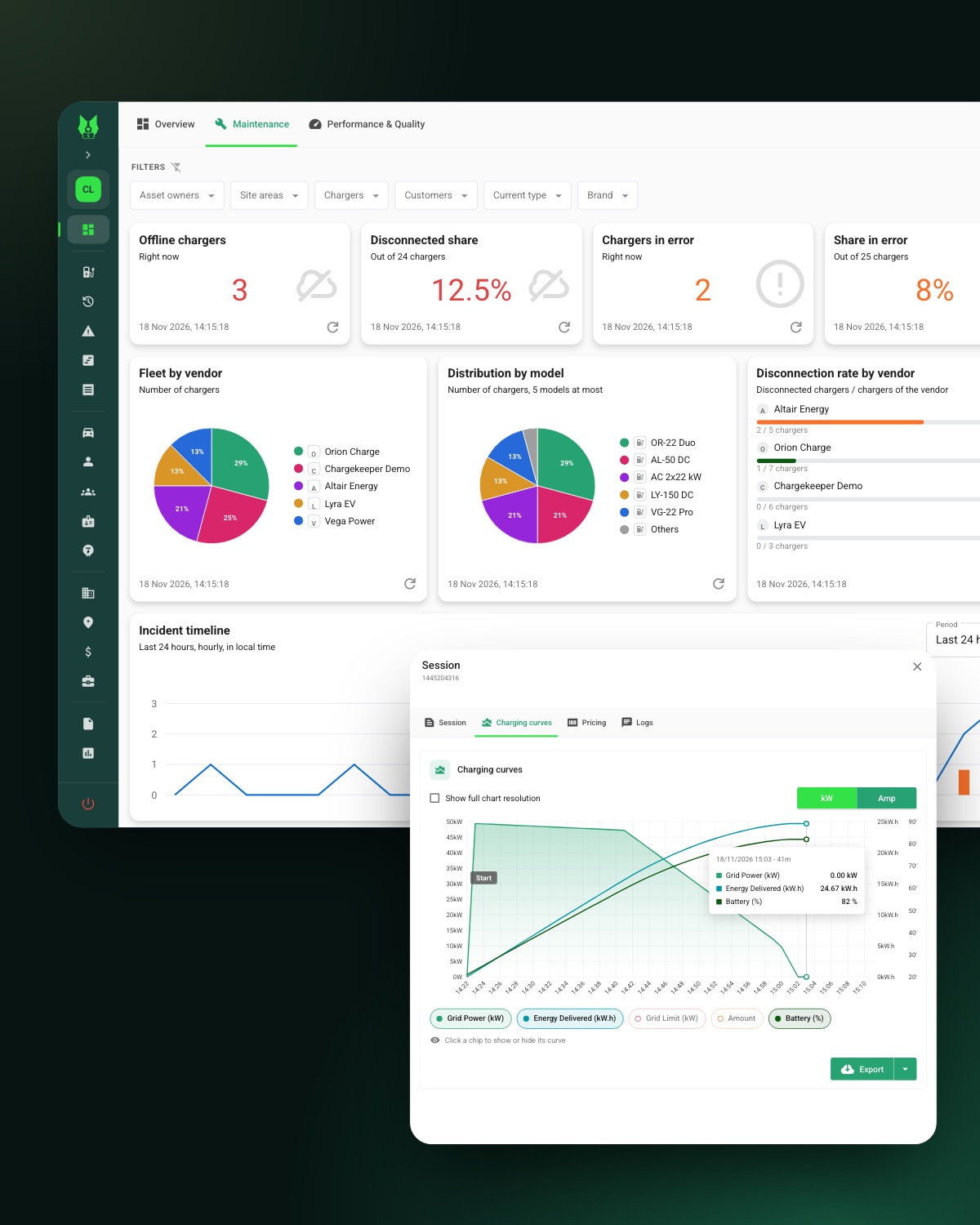
Choosing charging stations and choosing the software that will run them are two different decisions. The chargers deliver energy in the field. The CPMS — Charge Point Management System — connects that equipment to the operator’s business: supervision, maintenance, users, tariffs, payments, billing, roaming and energy management.
This choice commits the network for the long term. A CPMS that suits a handful of chargers can become a constraint once the number of sites grows, several hardware brands share the network, or the business opens up to public charging and eMSP partners.
Here is a practical method to build your requirements and compare platforms on operational criteria, rather than on a plain feature list.
1. Start from your operating model, not from the product demo
Before comparing screens, describe precisely the service you want to run.
- Will the network be private, public or mixed?
- How many sites, customer organisations and charging points are involved?
- Who monitors the chargers, and who steps in when something goes wrong?
- Do users pay per session, by subscription or through an employer contract?
- Do you need to accept third-party tokens or open the chargers to roaming?
- Does the available power have to be shared across several chargers?
- Should the software carry your brand, or your customers’ brand? See our white label and API offer.
The needs of a CPO, an eMSP mobility provider and an EV charging installer are not the same. A good platform must cover your current business while leaving room for it to evolve.
2. Check real compatibility with your chargers
“OCPP compatible” does not guarantee the same level of operation with every model. You need to check the protocol version, the functions the charger exposes and how deep the CPMS integration actually goes.
For each piece of hardware you are considering, ask in particular whether the platform can:
- report connector status and sessions in real time;
- start, stop or reboot remotely;
- change OCPP parameters;
- roll out firmware;
- apply charging profiles;
- use the meter data required for billing;
- diagnose errors from OCPP messages and logs.
A catalogue of compatible chargers and proven configuration templates reduce uncertainty at commissioning.
3. Assess the day-to-day operating tools
The value of a CPMS shows mostly when a charger stops working as expected. A demo should therefore show real operations, not just a summary dashboard.
Test the full journey: incident detection, finding the charger, reading the latest events, diagnosis, remote action and traceability of the intervention. Also check the quality of filters, alerts and access rights.
For a multi-customer network, the platform must clearly separate organisations, sites, users and roles. A technician may need operational access to several customers, while a manager must only see their own scope.
The CPMS supervision software page presents the main operational functions to look at.
4. Test monetisation and billing on your real cases
EV charging pricing models often combine several dimensions: energy consumed, plug-in time, parking time, time of day, user type or authentication method.
Prepare three or four representative cases and ask for them to be configured during the evaluation. For example:
- an employee charges for free within an internal policy;
- a visitor pays by card or QR code;
- a subscriber gets a specific tariff;
- a roaming driver uses a partner eMSP’s token.
Then check the whole chain: price calculation, transaction, receipt, invoice, any commission, refund and accounting export. If you serve businesses, also look at how B2B contracts and billing are handled.
5. Look closely at roaming and eMSP flows
Roaming lets a driver use a charger run by another operator. It usually relies on OCPI or OICP, through a hub such as GIREVE or HUBJECT, or through a direct relationship between partners.
Beyond the technical connection, you need to understand who controls the data, how CDRs are reconciled, how discrepancies are handled and how partners are invoiced. At high volume, the quality of eMSP clearing can have a direct impact on administrative time and revenue.
Ask which CPO and eMSP flows already run in production, which checks are automated and what information remains available in case of a dispute.
6. Don’t separate smart charging from the CPMS
The supervision platform knows which chargers are connected, which vehicles are charging and which constraints apply to them. It therefore sits at the centre of how available power is shared.
To assess smart charging, check:
- the allocation strategies on offer;
- how site limits and other loads are taken into account;
- the behaviour when communication is lost;
- how often charging plans are recalculated;
- compatibility with your EMS, your solar production or your battery;
- the visibility given to operations teams.
Energy optimisation that performs well but cannot be diagnosed can become an operational risk.
7. Check APIs, exports and data ownership
A CPMS does not live on its own. It may need to exchange data with an ERP, a maintenance tool, a mobile app, an energy management system or a business intelligence platform.
Ask for API documentation and test the operations that matter for your information system. Also identify which exports are available without custom development.
The contract must clearly state data ownership, return formats and reversibility terms. You must be able to retrieve the essential network information in a usable format, including chargers, users, sessions, consumption and transactions.
8. Treat security, compliance and continuity as product criteria
Security should not be assessed in an appendix once the solution has been chosen. A CPMS controls connected equipment, processes charging data and can trigger financial operations.
Your questionnaire should cover hosting, encryption of communications, access management, traceability of actions, backups, incident management and GDPR compliance. The Security and GDPR page (in French) details the commitments published by Chargekeeper.
Also question the vendor about its support: hours, languages, service levels, escalation procedure and assistance during critical phases.
9. Prepare the migration before you even sign
Even if your network is just starting, check the entry and exit conditions. An open platform must let you add chargers gradually and return your data if your strategy changes.
For an existing network, the comparison must include a migration plan: hardware inventory, OCPP versions, configurations, users, tokens, tariffs, history to carry over and roaming connections. A batch-by-batch cutover generally limits the risk.
Our article on switching CPMS platforms describes the main steps of this transition. The CPMS migration page presents our method: audit, pilot and batch-by-batch cutover.
A simple grid to compare CPMS platforms
Give each platform a documented score, based on evidence or a test.
| Area | Questions to validate | Expected evidence |
|---|---|---|
| Hardware | Are my chargers and OCPP functions covered? | Test on a real model |
| Operations | Can I diagnose and act remotely? | Demo of an incident |
| Organisation | Are roles, customers and sites properly separated? | Multi-entity walkthrough |
| Revenue | Can my tariffs and contracts be configured? | Billing simulation |
| Roaming | Are CPO/eMSP flows reconciled? | Example of CDRs and clearing |
| Energy | Does load management account for the site? | Power overrun scenario |
| Integration | Do the APIs cover my information system? | Documentation and test call |
| Data | How do I get my data back? | Export and reversibility clause |
| Security | Which controls and commitments apply? | Documentation and incident procedure |
| Support | Who answers when the network is down? | SLA and escalation path |
Questions to ask during the demo
A good demo should be able to answer these questions concretely:
- Show me a faulty charger and the diagnostic journey.
- How do you add a new charger brand?
- How do you separate two customers managed by the same partner?
- What happens if communication with the site is interrupted?
- How does a roaming session become a billed line?
- Can I export all my sessions and configurations?
- Which actions are available through the API?
- How do you organise a migration from my current tool?
The best CPMS is not the one with the longest feature list. It is the one that covers your critical operations, fits into your ecosystem and stays manageable as the network grows.
To compare Chargekeeper with your requirements, you can request a demo tailored to your network. We will use your operating cases, your charger models and your real flows as the common thread.